
BALATONFÜRED, HUNGARYSEPTEMBER 3–9, 2026
Megan Eckert ran636.5 miles.In six days.
Farther than any woman had ever run in six days. Farther than any American, man or woman.
Explore her six days Every mark is a lap. Shading shows night.Eckert won the EMU Six-Day Race, this year’s GOMU world championship, ahead of every other runner, man or woman. She covered 1,024.319 kilometers. She broke her own women’s world record and Joe Fejes’ American record, set in 2015. Her new women’s mark is pending ratification.
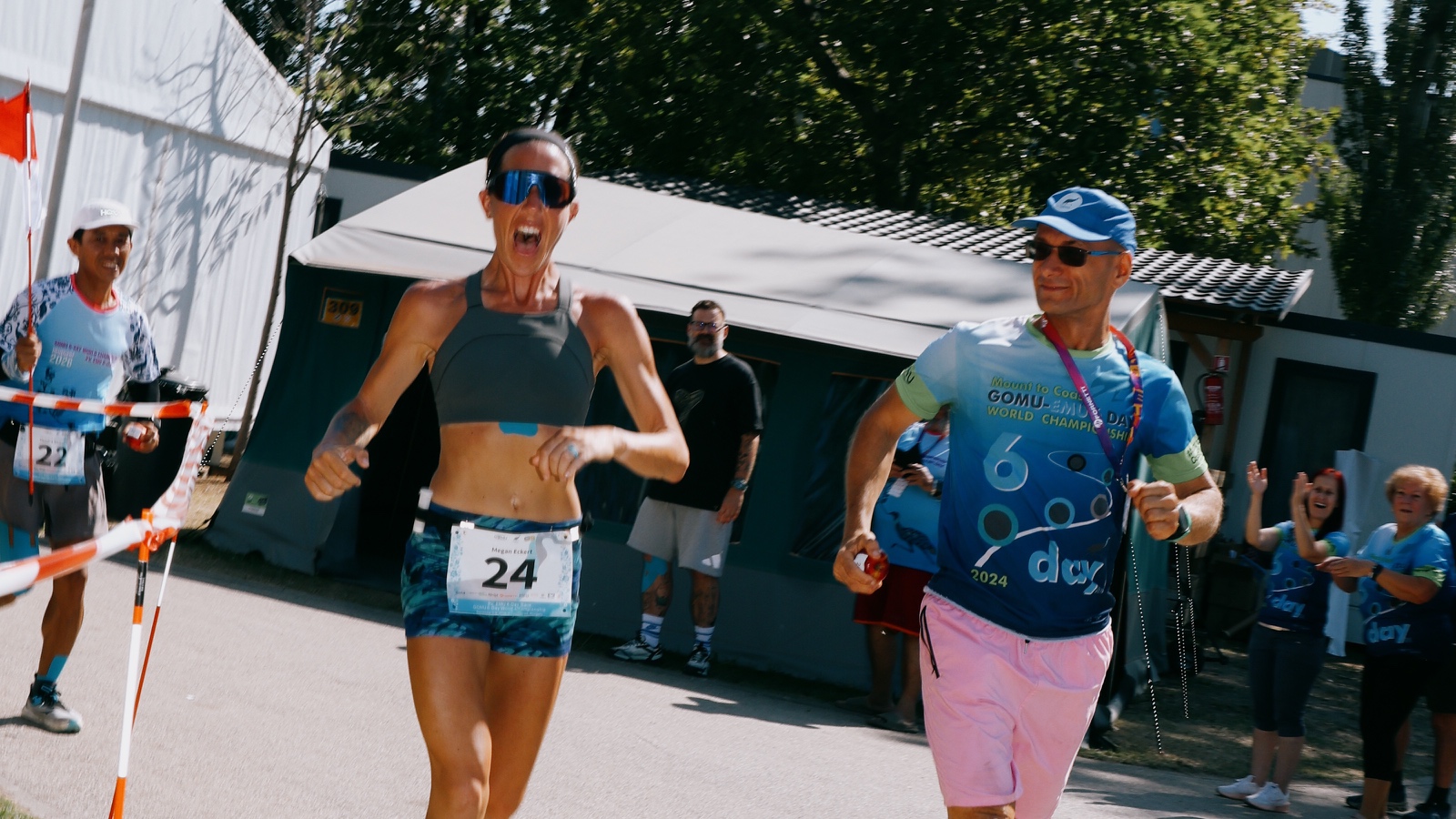
Eckert’s race headlined the September 9 issue of The Ultra Minute, our trail and ultrarunning newsletter. We wanted a closer look, so we used the official lap data to explore her six days and nights: the pace, the pauses, and the same loop, more than a thousand times.
THE SIX-DAY FORMAT
How far can you go
in 144 hours?
A six-day race has a time limit instead of a set distance. Runners circle a short course, choosing when to run, walk, eat or sleep. The clock keeps running through every break. Whoever covers the most ground wins.
At EMU, the course was 898.2 meters long. The race ran from noon September 3 to noon September 9.
A short history of six-day racing
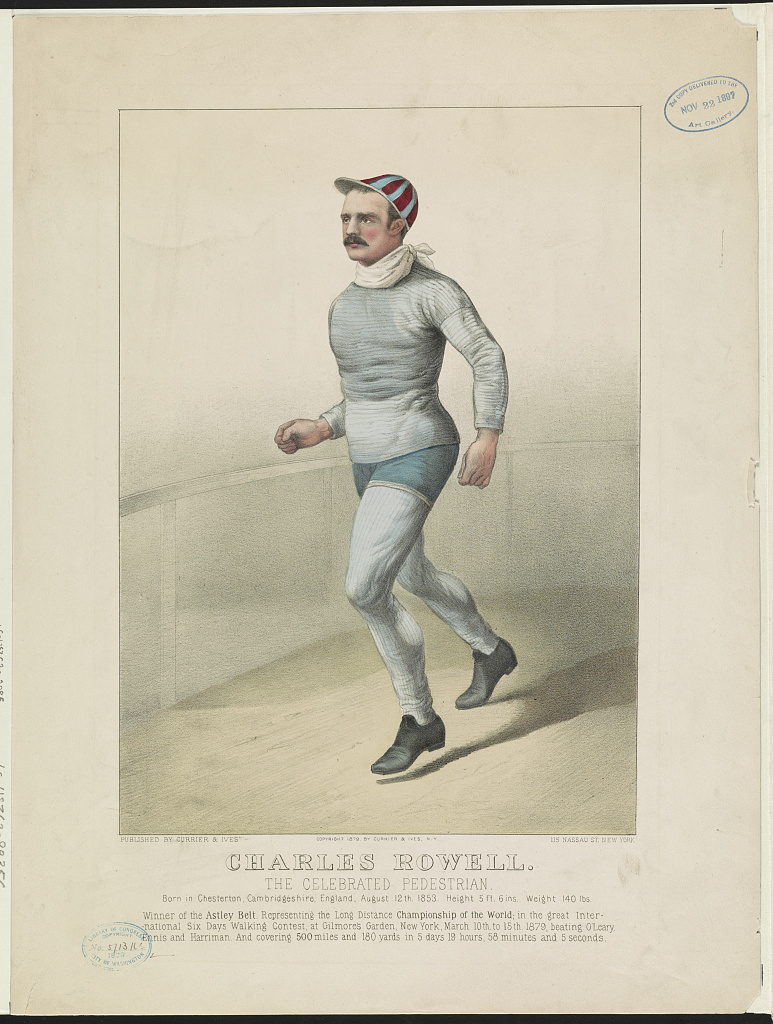
Currier & Ives / Library of Congress.
In the late 19th century, six-day races were a spectator sport. Crowds filled indoor arenas to watch long-distance walking contests, known as pedestrianism. These developed into races in which competitors could walk or run.
The modern revival began in 1980, when Don Choi organized a six-day race in Woodside, California.
Read the six-day racing study01 / THE RHYTHM
Six days of running,
one lap at a time.
Each green stroke marks a completed lap. Closely spaced strokes mean she was completing laps quickly. Wider gaps mean more time passed between laps. Blue shading shows the hours between sunset and sunrise. Select a spot to see the lap and its time.
Noon to noon, because the race started at noon on September 3 and finished at noon on September 9. All times are local to Hungary.
Click or tap anywhere on a row to select the nearest completed lap. The rust-colored band shows the interval before your selection.
LAP 570 OF 1,140
Sep 6, 7:26:53 AM · Hungary00:06:10 for this lap interval · 11:03 per mile, including pauses · 318.1 miles accumulated.
The shading uses local sunrise and sunset times; it includes twilight, not just full darkness. A gap includes the lap itself and any time away from the course. The timing record cannot tell us why it took longer. Lap source
02 / THE PACE
What pace was
she running?
Across the full six days, she averaged 13:34 per mile, including every meal, rest and pause. A typical lap was quicker: her median full-lap pace was 10:59 per mile. Lap times also include pauses. Both measures were slower at the end of the race.
13:34 / mileAverage across all 144 hours
10:59 / mileMedian of all 1,140 full laps
Minutes per mile · faster at the top
Read the daily pace figures
| Day | Median lap | Full-day average |
|---|---|---|
| 1 | 9:41 | 10:53 |
| 2 | 10:27 | 13:22 |
| 3 | 11:01 | 14:06 |
| 4 | 11:21 | 14:11 |
| 5 | 11:15 | 14:25 |
| 6 | 12:10 | 15:30 |
Calculated from official lap times and the 898.2-meter lap length. A lap interval includes any time off the course before she returned to the timing mat. Select any lap in the rhythm chart or lap explorer to see its pace.
How the miles added up,
day and night.
On each of the first five race days, she covered the fewest miles between midnight and 6 a.m. On day six, her lowest total came between noon and 6 p.m. Switch to whole days to compare her daily distances. The clock kept running during meals, rest and sleep.
Blue bars: midnight to 6 a.m.
132.3 miles in the opening day.
92.9 miles in the sixth.
636.5 miles across all six.
Each lap counts toward the block in which she finished it. The final measured partial lap is included. The U.S. 24 Hour Team’s updates described the race in six-hour blocks; this chart is rebuilt from official lap data.
03 / THE RECORDS
Only four runners
have gone farther.
Eckert now ranks fifth among six-day runners, men and women combined, counting each person’s best result. These are the five longest distances by different runners. Below them are two six-day records she broke: Joe Fejes’ American record and her own women’s world record.
Two six-day records she broke
She improved the women’s record by 33.3 miles and the American record by 30.2 miles.
Ranking as of September 10, 2026, combining DUV’s men’s and women’s all-time lists with Eckert’s new official result. She is fifth by runner and sixth by performance: Kouros also ran 639.4 miles in 1988. Different races had different surfaces and conditions.
04 / THE LAPS
The same loop,
1,140 times.
Every square below is one of her 1,140 completed laps. Move through the race: green squares are the laps she had finished, and the rust-colored square is the one you’ve selected.
THE COURSE
Less than a kilometer.
All six days here.
Each lap followed 898.2 meters of asphalt through Füred Camping in Hungary, with both left and right turns. Athletes kept the same direction throughout the race.
The outline follows the organizer’s 2026 course map. Arrows show the direction of travel. See the original map .
COMPLETED FULL LAPS
570 / 1,140DISTANCE AFTER THIS LAP
318.1 milesLap 570 ended Sep 6, 7:26:53 AM local time. 00:06:10 had elapsed since the previous lap ended, equivalent to 11:03 per mile including pauses. 570 full laps still to come.
Locate this lap in the day-and-night chart ↑One full lap = 898.2 meters. After lap 1,140, she added a measured 371.4-meter partial lap before time expired. The partial lap is included in the final result, but is not a square. Official timing record
THE FINISH / 1,024.319 KM
636.5 miles.
A women’s world record,
pending ratification.
Eckert finished 51.9 miles ahead of the runner-up. She added 33.3 miles to her own women’s world record and 30.2 miles to the American record. Only four runners have ever covered more distance in six days. Official results · Record report
The U.S. 24 Hour Team reported the first women’s six-day performance beyond 1,000 km. The record is pending ratification.
“I like to choose goals where I have a 50% chance of success and a 50% chance of failure.”
Explore the complete race +
Replay the top
three finishers.
Watch six days unfold in one minute, or drag the slider to any point. All three lines show distance covered since the start. Switch to Eckert’s lead to see her changing gap to the runner-up more clearly. Below zero means Holvik was ahead.
Elapsed race days
Eckert finished 51.9 miles ahead of Holvik.
Higher lines mean more distance covered. A flat stretch means no new lap was recorded.
Holvik was ahead after four days; Eckert was ahead after five. Distances update when a lap is recorded. Small fluctuations in the lead reflect runners reaching the timing mat at different moments; they do not identify the exact moment of an on-course pass. Final partial laps count at 144 hours.
Read the six daily checkpoints
| Elapsed | Eckert | Holvik | Čeliković |
|---|---|---|---|
| 1 day | 212.873 | 210.179 | 153.592 |
| 2 days | 386.226 | 379.939 | 288.322 |
| 3 days | 550.597 | 556.884 | 424.849 |
| 4 days | 714.069 | 729.338 | 552.393 |
| 5 days | 874.847 | 854.188 | 687.123 |
| 6 days | 1024.319 | 940.874 | 862.066 |
SOURCES & METHOD
Where the numbers come from
Eckert’s charts use her complete official lap record. The replay adds the next two runners in the final standings: Simen Holvik and Mario Čeliković. The race clock ran from noon September 3 to noon September 9, 2026, in Hungary.
How to read the timing and daylight
Full-lap distance is reconstructed from the published 898.2-meter lap length. At a time boundary we use the most recent recorded checkpoint. A lap that spans a boundary is credited to the period when it ends. Final totals include measured partial laps. Eckert’s 1,140 full laps total 1,023.948 km (636.3 miles). The final 371.4-meter partial brings her official result to 1,024.319 km (636.5 miles). Figures are rounded independently; one mile is 1.609344 km.
Race-day rows run noon to noon. Calendar-day rows run midnight to midnight, so September 3 and 9 each show only half a day of racing. Pale gray areas in those rows fall outside the race. Sunset-to-sunrise shading uses minute-resolution Time and Date calculations for Balatonfüred. It includes twilight and does not represent measured light on the course.
A long interval between laps includes the time to cover a lap plus any time off the course. We do not infer sleep, moving pace, the reason for a pause, or exact on-course passing times. The pace chart uses every full lap, including long intervals. A lap is assigned to the day it ends; daily elapsed pace divides 24 hours by the distance credited to that day. The six-day average includes the final partial lap. Median lap pace excludes that partial lap. Pace is rounded to the nearest second per mile. Download lap data · Download comparison and daylight data.
How is the all-time ranking calculated?
We checked DUV’s all-time six-day lists for both sexes and added Eckert’s September 9 result, which was not yet listed. Four men have best results above her distance; no other woman does. The top five chart counts each runner once. The two additional rows are prior records, not ranks six and seven. For Fejes, we use the 975.653 km record reported by iRunFar; DUV lists one meter more, which does not change the displayed miles or comparison. The American-record improvement is calculated before rounding: (1,024.319 − 975.653) ÷ 1.609344 ≈ 30.24 miles, displayed as 30.2. Subtracting the separately rounded totals of 636.5 and 606.2 gives 30.3 instead. Names on the chart link to the sources for their final totals. We have not verified historical lap sequences, so we do not draw historical pacing curves.
An independent editorial project by The Ultra Minute. Timing: Korido / EMU. Historical results: GOMU, IAU and iRunFar. Daylight: Time and Date.

FROM THE ULTRA MINUTE
Trail and ultrarunning, in one quick read.
Stay on top of trail and ultrarunning without spending your day on Instagram. The Ultra Minute brings you the results, records and news that matter, with links when you want to go deeper.
We made this special because Eckert’s race deserved a closer look, and we thought the data would be fun to explore. Congratulations, Megan.
Subscribe to The Ultra Minute